Assign Responsibility
When given serious responsibility, we tend to take it seriously and almost always rise to the challenge. The best organizations know this well. They don’t assign tasks to their people, they assign responsibility.
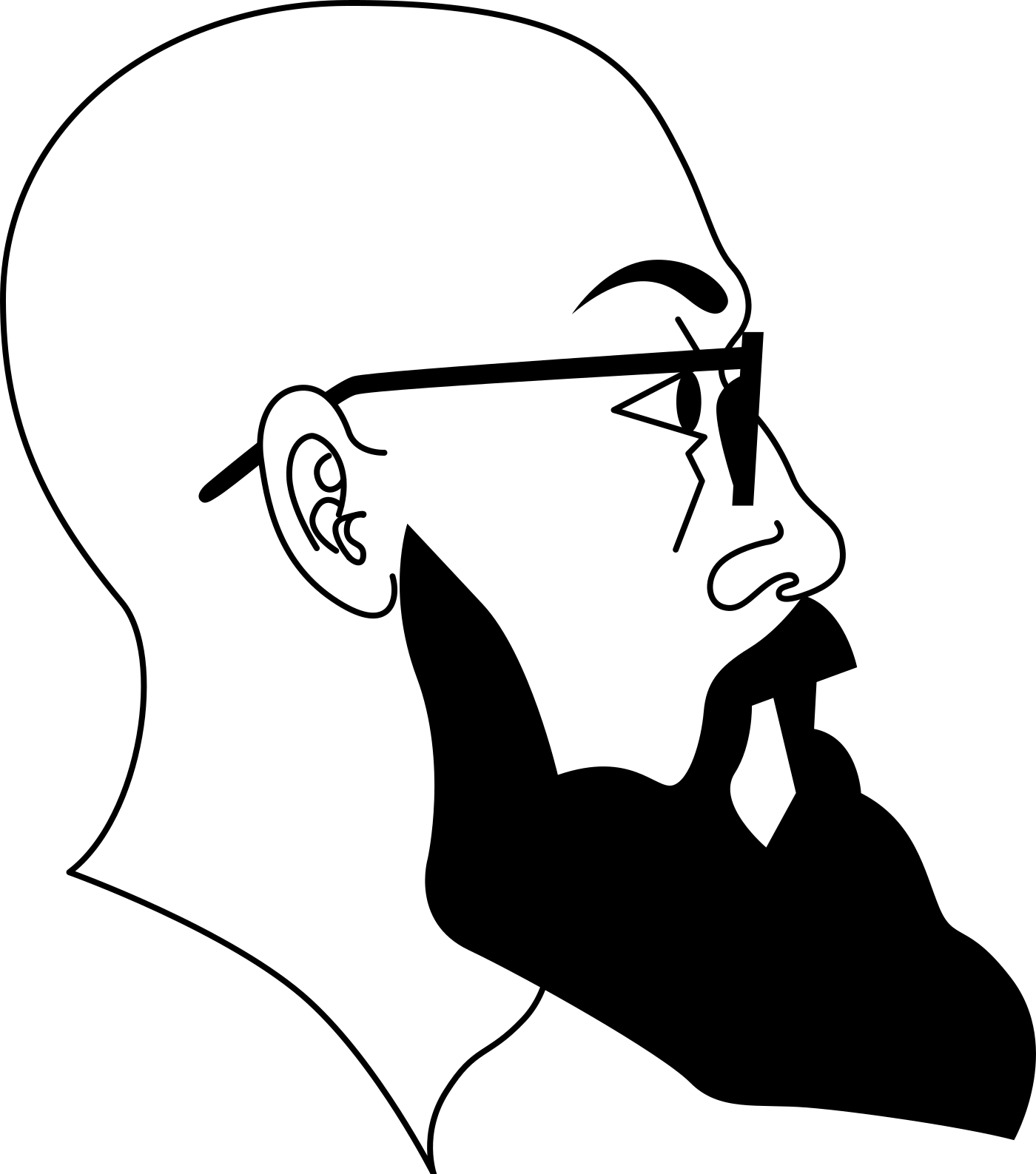
My name is Nick Pruitt. I’m a web designer, as in I do graphic design and front end development for things on the internet. I’m also a chronic doodler, and my coffee most likely tastes better than your coffee.
When given serious responsibility, we tend to take it seriously and almost always rise to the challenge. The best organizations know this well. They don’t assign tasks to their people, they assign responsibility.
They don't write to fill up space on a page. They write to fill up your head. There is nothing inherently interesting about liquidators, leather, or farmers. They can make themselves boring, or they can make themselves interesting. Words do that job. Woot, Saddleback, and Polyface have all chosen to be interesting and engaging. They don't hide behind jargon. They aren't insecure. They aren't afraid to tell you who they are.
Erik SpiekermannMy life's work isn't what I've done, but it's the people that I've influenced. I find much more satisfaction in having trained or educated people.
Erik SpiekermannWe have skin, not metal cladding. Eyes, not OCR. Feelings, not sensors.
- Perhaps you don't know enough
- Perhaps you don't care enough, or
- Perhaps you're unable to execute because of committees, the status quo and fear
Think of the flipside of this as well. What would happen when…
When I start sketching ideas for a design, I always simply list the purpose of the project I’m working on and the main problems I’m solving and objectives I’m working to accomplish. I think a mission statement for your product is important, which is basically what a Make Mantra is, but it’s more direct with only a few words. I think a Make Mantra for whatever I'm working on will be added to the growing post-it note collection on my desk.
Jon AcuffYou have the perfect amount of time each day for the things that matter most. The key is spending time on those things.
We’ve all been there. We’ve been at the moment where a feature for our application has to be there and it must be done a certain way. You’ve thought it through, you’ve crafted a solution, and you’re excited about what you’re going to create. But then, someone tells you that you don’t have the time or resources to do it by the next release. The bomb has been dropped, what are you going to do?
I think in this moment there are three main routes you can take.
Sometimes that thing you think you need so badly isn’t even something you really need. If you’ve put in the time and thought that my dramatic intro suggests you have probably already vetted the feature pretty thoroughly. But you can use the “we can’t do it” moment as an opportunity to sanity check yourself. Is this truly useful for our users? Maybe it’s from an old parking lot list of features, and it’s not even relevant anymore. It’s never bad to ask yourself this question, even if you’ve been thinking and planning a feature for a while, or even if you perceive it as important in the moment.
Another good question to ask yourself is, “Do I really need this right now?” We sometimes have a bad habit of solving problems we don’t have yet. It makes sense, we’re always thinking about users and the problems they’ll encounter, or our system and the little things we want to perfect and offer users to make their experience better and better. Those problems might be real, but sometimes they’re just not a problem yet. It’s always good to ask this to ensure that you don’t paralyze yourself for no reason.
At the core of this feature should be a value to the users of your product. At its core, you should be solving a problem. The next option is to find a different way to solve that problem. This means it’s time to get really creative with how you approach this thing. It’s time to think about it from a totally different slant. It’s time to go all MacGyver on it, look at what you have available, and still craft an awesome solution. This can actually lead to something great. Maybe you were making it too complicated and you find it should actually be simpler, or maybe you find an easier, faster way to solve it. This can be a great way to keep yourself sharp and really analyze your work and the steps involved in it.
This can piggyback off the last two routes, or can stand on its own. This is where you ask the question, “Is there something we can do now that will make this easy to implement later?” That feature might need a foundation to stand on before it should even be brought to life, a foundation that you haven’t built yet. This is a great opportunity to break your feature down into its simplest pieces and tackle it step by step. Maybe it’s not as complex as you think, maybe it’s more complex. Either way, this allows you to get easy wins, create momentum, and really knock the thing out, which is what you want in the first place. No one loves a long, drawn out project. Turn your large project into a set of easy wins, however, and you can plow through it.
It’s easy to panic or get offended or angry when you’re told that you can’t do something. But inside that moment, there is opportunity. You just have to keep your wits about you, stay calm, and think it through. Your job is important and what you do matters, but chances are a feature on a website isn’t a life or death situation. Transform that problem into an opportunity to do something better and into an opportunity to challenge yourself and grow.
This article was written twelve years ago for A List Apart by John Allsopp, and it rings especially true today amid all the discussion of responsive and adaptive web design and mobile first. Really these things are just pieces of truly building an accessible and flexible web for our users. I think we have come full circle to where we started. We have a better idea what is ahead of us, and even then, we are only at the beginning. Here are some of my favorite quotes from the article.
The control which designers know in the print medium, and often desire in the web medium, is simply a function of the limitation of the printed page. We should embrace the fact that the web doesn’t have the same constraints, and design for this flexibility.
The flexibility I’ve talked about so far I think of as “adaptability“. Everything I’ve said so far could be summarized as: make pages which are adaptable. Make pages which are accessible, regardless of the browser, platform or screen that your reader chooses or must use to access your pages.
The web’s greatest strength, I believe, is often seen as a limitation, as a defect. It is the nature of the web to be flexible, and it should be our role as designers and developers to embrace this flexibility, and produce pages which, by being flexible, are accessible to all.
Future-friendly thinking encompasses lots of ideas: web standards, content strategy, progressive enhancement, responsive design, and more. However, it’s far bigger than any one approach, technology or technique. It’s here to help us think beyond our current project scopes and help us prepare for a future filled with innovation and constant change.
Have a vision and strategy that serves your users well, code flexibly with a solid structure, and embrace opportunities to make things better for others today and in the future.